
Productivity
-
Six Months with Git-Native Issue Tracking: Am I Still Using Beads?
Back in January, I wrote about discovering beads, a git-native issue tracker built specifically for AI-assisted development. I was pretty hyped. Having agents track their own tasks natively inside the git repo felt like the missing link for long-running autonomous workflows.
It’s been six months. So, the inevitable question: am I still using it?
Short answer: yes, but no longer as my default.
So this is where my task-tracking workflow actually landed in mid-2026.
The Shift Away From the Default
In January, I was trying to force beads into every single project I spun up. New repo? Init beads. Quick experiment? Init beads. As the months went on, I realized I was over-engineering things.
For a lot of projects, the task tracking built into Claude Code is good enough for day-to-day work. If an agent just needs to hold a checklist for a couple of hours during a coding session, standing up a full git-native tracking system is overkill. The lightweight, ephemeral tasks handle that perfectly, and they disappear when the session ends, which is exactly what you want for session-scoped work.
Wrapping the Real Things
For durable issue tracking, I pivoted back to where the code already lives.
Instead of leaning on beads, I built a couple of custom agent skills that wrap the GitHub CLI (
gh) and the GitLab CLI (glab). Now when an agent needs to pull down tasks, update tickets, or log a blocker, it just talks directly to GitHub or GitLab through those wrappers.The split looks like this: the remote issue tracker is the source of truth, and lightweight Claude Code tasks handle immediate session context. That combination has been far more resilient for me than routing everything through a separate system. The truth stays where my teammates and my future self will actually look for it.
Where Beads Still Lives
I haven’t abandoned beads. It still sticks around on a handful of repos where it’s useful.
The big one is my Obsidian vault, the “second brain” I wrote about earlier this week. When I’m managing personal research, blog pipelines, or local-only projects that don’t need a heavy GitHub project board, the git-native approach is still fantastic. No remote, no API, no ceremony, just issues that travel with the repo. Version 1.0 leaned into that even harder by moving to an embedded Dolt backend, basically git for your database, so there’s no separate server to babysit and the full history lives right alongside the code.
Beads isn’t worse than I thought in January. It’s just a sharper tool than I was treating it as. I was reaching for it everywhere when it was really built for a specific shape of project.
The hype of January has settled into the pragmatism of June. Not every project needs a custom tracking system, and sometimes letting your agents talk to GitHub directly is the easiest path forward.
What are you using to keep your agents on task these days?
I’d appreciate a follow. You can subscribe with your email below. The emails go out once a week, or you can find me on Mastodon at @[email protected].
-
Voice-to-Text in 2026: The Tools and Models Worth Knowing About
As natural language becomes a bigger part of how we build software, it’s worth looking at the state of transcription models. What’s the best way to get voice to text right now?
For a lot of people, talking to your computer is faster than typing. You can stream-of-thought your way through an idea, prompt your tools, and get things moving without your fingers being the bottleneck. If you haven’t tried it yet, it will change how you work with your machine. I’m not exaggerating.
The Tools
Here’s what people are actually using for desktop voice-to-text:
- Willow Voice — Popular choice, lots of people swear by it
- SuperWhisper — My current pick
- Wispr Flow — Another well-regarded option
- Voice Ink — Worth a look?
- Aiko — From an Open Source dev, Sindre Sorhus
- MacWhisper — Solid Mac-native option
I’ve tried several of these, and the biggest pain point for people is going to be that many require monthly subscriptions. I’ve been happy with SuperWhisper and it is worth mentioning they still have a pay for it once (Lifetime) option, so you don’t get locked into monthly payments forever. That said, Willow Voice and Wispr Flow both have strong followings.
The Models Behind the Magic
Most of these tools started with OpenAI’s Whisper, the voice model released and open-sourced back in 2022. With Whisper, you could run solid transcription locally on your own hardware.
But we’re a few years past that now, and there are some more models to choose from. Here is a summary table of the current state of the transcription models.
---Model Company Released Local Run? Used in Desktop Tools? Best For Whisper Large-v3 OpenAI Nov 2023 Yes Yes (The Standard) Multilingual accuracy (99+ langs) Whisper v3 Turbo OpenAI Oct 2024 Yes Yes (Fast Settings) Best speed-to-accuracy ratio for local use Nova-3 Deepgram Apr 2025 Self-Host Limited (API-based) Real-time agents; handling messy background noise Parakeet TDT 1.1B NVIDIA May 2025 Yes Developer-focused / CLI Ultra-low latency; significantly faster than Whisper SenseVoice-Small Alibaba July 2024 Yes Emerging (Fringe) High-precision Mandarin/English and emotion detection Canary-1B NVIDIA Oct 2025 Yes Developer-focused Beating Whisper on technical jargon & punctuation Voxtral Mini V2 Mistral Feb 2026 Yes Yes (Privacy apps) High-speed local transcription on low-VRAM devices Granite Speech 3.3 IBM Jan 2026 Yes No (Enterprise focus) Reliable technical ASR with an Apache 2.0 license Scribe v2 ElevenLabs Jan 2026 No Via API Extremely lifelike punctuation and speaker labels We’re at an interesting inflection point. You can articulate your thoughts faster by speaking than typing, its becoming a real productivity gain. It’s not just an accessabiltiy aid anymore. People who can type well enough are using these tools on a daily basis.
That’s all for now!
-
Claude Code Prompts for Taming Your GitHub Repository Sprawl
Some useful Claude Code prompts for GitHub repository management.
1. Archive stale repositories
Using the GitHub CLI (gh), find all of my repositories that haven't
been pushed to in over 5 years and archive them. List them first and
ask for my confirmation before archiving. Use gh repo list <user>
--limit 1000 --json name,pushedAt to get the data, then filter by
date, and archive with gh repo archive <user>/<repo> --yes.
2. Add missing descriptions
Using the GitHub CLI, find all of my repositories that have an empty
or missing description. Use gh repo list <user> --limit 1000 --json
name,description,url to get the data. For each repo missing a
description, look at the repo's README and any other context to
suggest an appropriate description. Present your suggestions to me
for approval, then apply them using gh repo edit <user>/<repo>
--description "<description>".
3. Add missing topics/tags
Using the GitHub CLI, find all of my repositories that have no topics.
Use gh repo list <user> --limit 1000 --json name,repositoryTopics,
description,primaryLanguage to get the data. For each repo with no
topics, analyze the repo name, description, and primary language to
suggest relevant topics. Present your suggestions for approval, then
apply them using gh api -X PUT repos/<user>/<repo>/topics
-f '{"names":["tag1","tag2"]}'.
To make #1 easier, repjan is a TUI tool that pulls all your repos into an interactive dashboard. It flags archive candidates based on inactivity and engagement, lets you filter and sort through everything, and batch archive in one sweep. If you’ve got hundreds of repos piling up, it’s way faster than doing it one by one.
-
Beads: Git-Native Issue Tracking for AI-Assisted Development
If you’re working with AI coding agents like Claude Code, you’ve probably noticed a friction point: context.
Every time you start a new session, you’re rebuilding mental state. What was I working on? What’s blocked? What’s next?
I’ve been using Beads, and it’s changed how I manage work across multiple AI sessions.
What Makes Beads Different?
Beads takes a fundamentally different approach. Issues live in your repo as a
.beads/issues.jsonlfile, syncing like any other code. This means:- No context switching: Your AI agent can read and update issues without leaving the terminal
- Always in sync: Issues travel with your branch and merge with your code
- Works offline: No internet required, just git
- Branch-aware: Issues can follow your branch workflow naturally
The CLI-first design is what makes it click with AI coding agents. When I’m working with Claude Code, I can say “check what’s ready to work on” and it runs
bd readyto find unblocked issues. No copying and pasting from a browser tab.Getting Started
Getting up and running takes about 30 seconds:
# Install Beads
curl -sSL https://raw.githubusercontent.com/steveyegge/beads/main/scripts/install.sh | bash

# Initialize in your repo
bd init

# Create your first issue
bd create --title="Try out Beads" --type=task
From there, the workflow is straightforward:
bd readyshows issues with no blockersbd update <id> --status=in_progressto claim workbd close <id>when you’re donebd syncto commit beads changes
Why This Matters for AI Workflows
The real power shows up when you’re juggling multiple tasks across sessions. Your AI agent can:
- Pick up exactly where you left off by reading the issue state
- Track dependencies between tasks (this issue blocks that one)
- Create new issues for discovered work without breaking flow
- Close completed work and update status in real-time
I’ve found this especially useful for longer projects where I’m bouncing between features, bugs, and cleanup tasks. The AI doesn’t lose track because the state is right there in the repo.
Is It Right for You?
Beads isn’t trying to replace GitHub Issues for team collaboration or complex project management.
It’s designed for a specific workflow: developers using AI coding agents who want persistent, agent-friendly task tracking.
If you’re already working with Claude Code, Aider, or similar tools, give it a try. The setup cost is minimal, and you might find it solves a problem you didn’t realize you had.
-
Why Airtable Killed Google Sheets for Me
It’s 2026, you should probably stop using Google Sheets or Microsoft Excel for most things. What follows is my attempt at explaining why Airtable (and other similar products) are better.
Data Integrity Actually Exists
In Google Sheets, a cell can be anything. A string, a date, a number, whatever you accidentally paste into it. There’s no real way to enforce data types beyond formatting tricks or functions that break when someone inevitably ignores them.
In Airtable, you define what a column is. It’s a date field. It’s a number. It’s a single select. And it stays that way. No more spreadsheets slowly devolving into data hellscapes where row 47 has a phone number stored as text and row 48 has it as a number.
Relationships Without the Visual Basic Nightmare
Want to connect data across multiple sheets in Google? Get ready to write formulas. You’re essentially writing code, Visual Basic or Apps Script, just to link your tables together.
In Airtable, relationships are native. You click a few buttons, link two tables, and boom, you’ve got the equivalent of a SQL join without writing a single line of code. The data stays connected, and you can traverse those relationships naturally.
Attachments That Don’t Suck
Google Sheets handles attachments by letting you paste a link to a file somewhere else. Maybe it’s in Google Drive, maybe it’s on some random server. Either way, it’s just a URL sitting in a cell.
Airtable lets you drag files directly into a cell. They get thumbnails. They’re actually attached to the record. Sure, on the backend it’s probably still stored in a bucket somewhere, but the interface abstracts all that away. It just feels like the file belongs there. Good file, that’s a good boy, go sit in your cell.
Views That Make Sense
In Sheets, you get a grid. Maybe you can set up a filter view if you know how. That’s about it. Airtable gives you options out of the box: grid view, Kanban board, calendar, gallery, timeline.
You can look at the same data in completely different ways depending on what you’re trying to accomplish. Want to see your projects as cards on a board? Done. Want to see them as events on a calendar? Also done. No formulas, no hacks. Notion has entered the chat
Automation Without Writing Production Code in a Spreadsheet
This one really gets me. Want to automate something in Google Sheets? Time to open Apps Script and write JavaScript. I hope you’re comfortable debugging code that has no unit tests, no version control, and will silently break at 2 AM when you’re asleep.
Airtable’s automation is point-and-click. Set a trigger, define actions, connect to integrations. It’s like Zapier or n8n built right into your database. When this field changes, send that notification. When a record is created, add it to another table. No code required.
The Row Editing Experience
This might seem minor, but it’s not. When you want to focus on a single row in Google Sheets—really dig into one record and edit multiple fields—you’re clicking into cells and scrolling horizontally to find column 30 while trying not to lose your place.
Airtable has an expanded record view. Click on a row and it opens up vertically, showing you every field in a clean, organized layout. You can actually see what you’re editing. Nice.
Look, Google Sheets isn’t going anywhere, and we should all probably be happy it still exists….. but yeah, the spreadsheet paradigm had a good run and it’s time to move on.
For anything that resembles actual data management, where you need integrity, relationships, and a UI that doesn’t fight you, Airtable (or Notion, or similar tools) should be your first choice.
What do you think? Have I missed anything?
-
Threads was perfect cause last year …
so yea;
I’m back to blogging. I need to build my own custom Microblog theme, though.
Go to my Website to see the silly Canva video I made instead of configuring a Debian Server with Ansible using a tool that makes using Docker Swarm more manageable.

-
As I am writing this, I am petting a cat. My cat. You want to know how? I use a voice to text thing called Super Whisper. It transcribes my audio to text locally. I have a history of my prompts and transcriptions. Incredibly useful.
-
reply if you see this 🫶
new pfp?

-
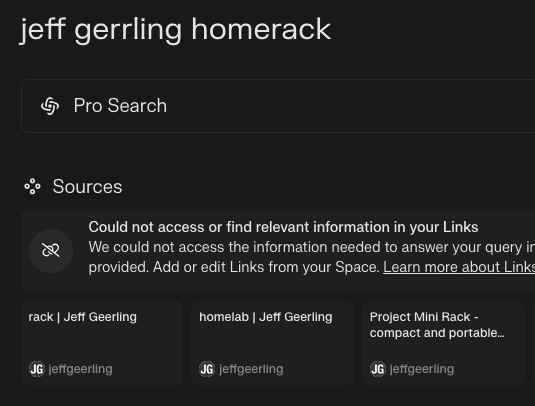
You'll never guess what I was searching Perplexity AI for just now.
You'll never guess what I was searching Perplexity AI for just now.
- Can you provide examples of successful mini rack builds?
- What are the main benefits of using a mini rack for a home lab?
- A mini rack sommelier.
- I dabble in the racks of mini
- I'm somewhat of a mini rack connoisseur.
- Jeff Geerling's sweet MINI RACK
Ok, if you made it this far, you weirdos. Here is my MiniRack Dojo
https://www.perplexity.ai/collections/minirack-dojo-qotiBcSJSQekqymojD66Ow
-
How to Pick the Best Blog or Newsletter Platform in 2025

In 2025, blogging and newsletters remain essential tools for creators, businesses, and professionals. However, choosing the right one can be challenging with many available platforms. Whether you’re a beginner, a tech-savvy developer, or an established creator looking to monetize your content, this guide will help you navigate the options.
Key Factors to Consider
When evaluating platforms, consider the following:
• Ease of Use: Does the platform fit your technical skills?
• Customization: How much control do you want over design and functionality?
• Community and Discoverability: Does the platform help you grow your audience?
• Monetization Options: Can you earn money directly through the platform?
• Content Ownership: Do you retain control over your content?
• Cost: Does the platform align with your budget?
Use Cases and Recommendations
1. Beginners or General Use
For those new to blogging or looking for simple, user-friendly platforms, these options stand out:
• Medium: Ideal for casual bloggers who want to focus on writing and gain access to a built-in community.
• Micro.blog: Supports short-form and long-form blogging with cross-posting to Mastodon, Threads, and BlueSky. Great for personal sites with minimal monetization needs.
• Squarespace: Excellent for visually appealing blogs with drag-and-drop design and robust hosting.
• WordPress.com: Offers beginner-friendly features, extensive plugins, and SEO tools. It’s a solid choice if you want a customizable blog and don’t mind some maintenance.
2. Creators Focused on Newsletters or Monetization
For creators prioritizing audience growth and revenue, these platforms excel:
• Ghost: Combines blogging and newsletters with built-in subscription and membership tools. Ideal for creators seeking an all-in-one platform.
• Beehiiv: Designed for scaling newsletters with robust analytics and monetization options.
• Buttondown: Simple and lightweight, perfect for indie creators starting out with email subscriptions.
• Mailcoach: Self-hosted, providing full control over your newsletters without ongoing fees.
3. Tech-Savvy Developers
For developers who want complete control over their blogging setup:
• Hugo, Astro, or NextJS: Static site generators for blazing-fast performance and maximum customization. Requires technical expertise.
• WriteFreely: Open-source blogging software with minimalist, distraction-free writing.
• Hashnode: A tech-focused platform with GitHub integration and a developer-friendly audience.
4. Professionals and Thought Leaders
For business professionals aiming to grow their brand or network:
• LinkedIn Articles: A natural choice for thought leadership with built-in networking opportunities.
• Medium: Provides discoverability and a broad audience for professional writing.
Why You Might Want to Switch Off WordPress in 2025
WordPress has been a dominant blogging platform for years, but it’s no longer the best fit for every use case. Many users find its maintenance and performance issues burdensome. Here’s why you might consider switching:
• High Maintenance: Regular updates and plugin management can be time-consuming.
• Performance Issues: Without careful optimization, WordPress sites can become slow.
Better Alternatives for Specific Use Cases:
• Micro.blog: Great for personal blogs or creators who value simplicity.
• Ghost: Modern, fast, and equipped with monetization tools.
• Medium: Excellent for writing-focused creators seeking discoverability.
• Squarespace: A better fit for e-commerce or visually polished websites.
The Importance of Choosing Platforms with Good Content Policies
The content policies of a platform shape the kind of community it fosters and, by extension, the broader digital landscape. When choosing a blog framework or newsletter platform, it’s essential to consider how they address hate speech, harassment, and harmful behavior.
Platforms with clear and well-enforced content policies create spaces where diverse voices can thrive, and users feel safe. By supporting these platforms, we help build an internet that promotes constructive dialogue and meaningful engagement.
As creators, the platforms we choose reflect our values. Prioritizing platforms with strong content policies isn’t censorship; it’s about ensuring safe, inclusive spaces where everyone can participate respectfully. Together, we can contribute to a better, more responsible internet.
To help you choose the best platform for your blog or newsletter, I’ve compiled a comprehensive spreadsheet comparing 20 different services.
This resource covers key details like pricing, ease of use, audience suitability, and—importantly—their policies on hate speech, including links to their content policies.
I created this spreadsheet by thoroughly researching each platform’s features and policies to provide you with the essential information needed to make an informed choice…
👉 Here’s a link to the spreadsheet 👈
I hope that it saves you time and helps you find a platform that aligns with your values and goals.
Substack: A Troubling Example
Substack is popular for newsletters but criticized for its approach to hate speech. The company has stated it won’t remove Nazi content or other white supremacist ideologies unless it incites direct violence. This permissive stance has made it a hub for harmful ideologies.
Ask Yourself:
• Do you want to support a platform that tolerates Nazi content?
• Are you comfortable associating your brand with Substack’s content policy?
Platforms With Stronger Content Policies
• Ghost: Enforces clear guidelines against hate speech and white supremacy.
• Medium: Takes a strong stance against hateful content, fostering a positive community.
• Buttondown: Ethical and straightforward, with a commitment to inclusive content.
~~~~~~~~~~~~~~~~~~~~~~~~~~~~~~~~~

~~~~~~~~~~~~~~~~~~~~~~~~~~~~~~~~~
This guide has been helpful as you consider the best platform for your blog or newsletter? Well, I hope anyway.
Remember to be thoughtful about your choice; not just for features but for the online environment you want to support.
If you’d like to stay updated with more posts like this, consider subscribing to my newsletter.